Overview
Gallify started as a small AI-focused team. I joined early and became Chief Product Officer and a co-founder. Over five years I led product, ran engineering through a lot of hiring, and in the end recommended that we wind the company down.
Digital artists had nowhere to show and sell their work that felt like a gallery. Collectors couldn’t see a piece in their own space, and couldn’t prove they owned it. So we built an iOS app with galleries you could create and share in minutes, AR to see any piece on your wall at its real size, and ownership recorded on a blockchain.
Illustrative.
Problem and research
Back then digital art mostly lived on social feeds built for photos. Artists could post, but there was no place that treated a piece of digital work with the presence a gallery gives a painting. For collectors there were two gaps. They couldn’t tell how a piece would look at home, which is how most people decide to buy art. And they had no reliable way to prove they owned what they bought.
Our positioning was “a next generation gallery for the digital age”, meaning you create a gallery and share it instantly. We bet that seeing a piece on your own wall and being able to verify you owned it would make digital art feel like it counted, and that good discovery would help collectors find work they’d never have searched for.
Discovery and early design
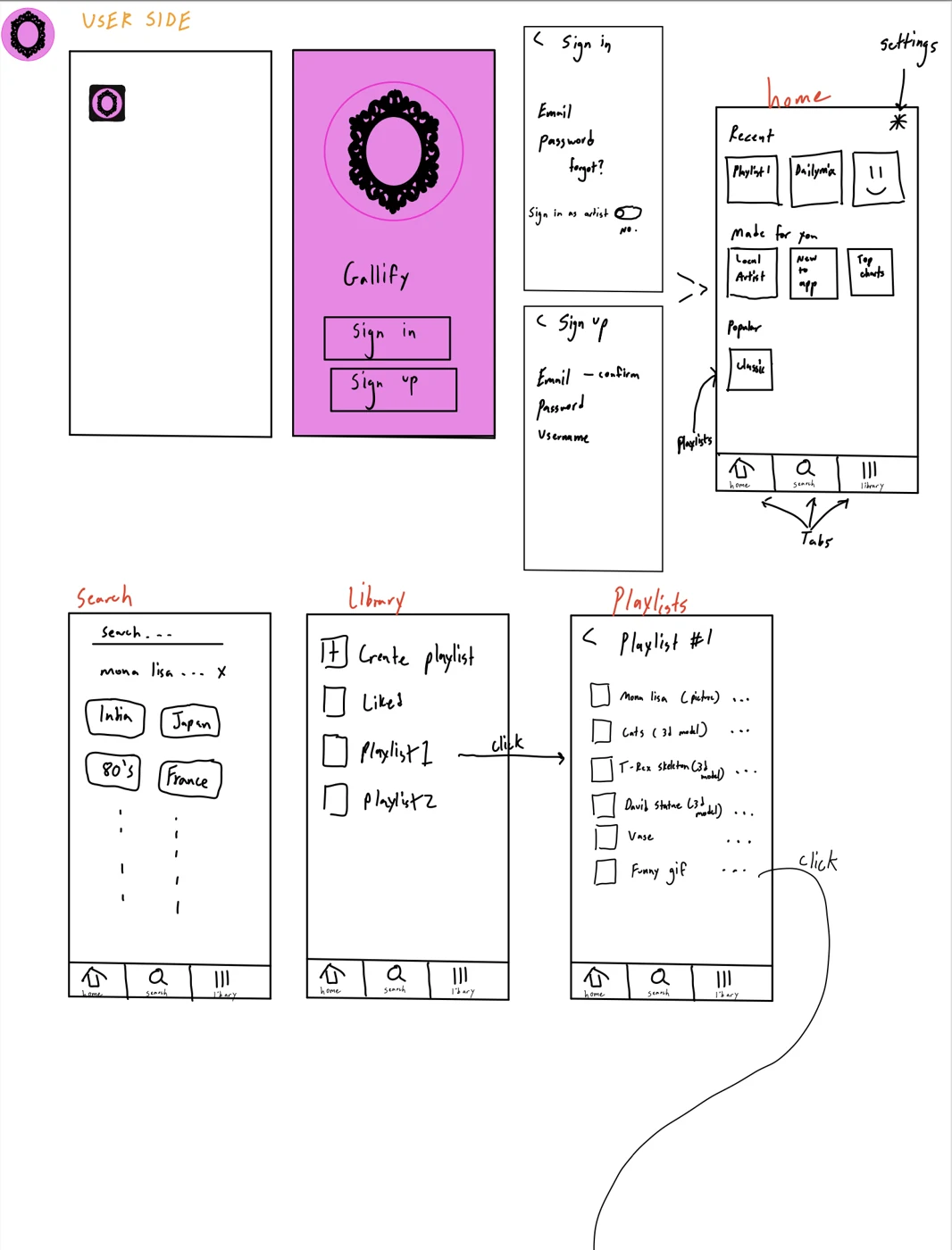
We started with flows before screens. I sketched sign-up, the library, playlists and search by hand and argued over the paths with the team until we agreed on them. Only then did we move to high-fidelity iOS designs, and after that to a beta landing page with a Discord community for early feedback.
The sketches cover what mattered at the start: how an artist creates a gallery, how a collector builds a library of favourites, and how playlists let people share taste. A few of those ideas survived and a lot of them didn’t. Starting on paper meant changing our minds cost us nothing.
The beta page said “Create a gallery and share, instantly,” and we used that sentence to test every feature. Did it make the first gallery faster to create, or easier to share?
Solution
Product decisions
Discovery over search
Collectors rarely know what to search for, so the home screen is a per-collector feed with local auctions by city, curated playlists and a featured room, instead of a search bar.
AR as the differentiator
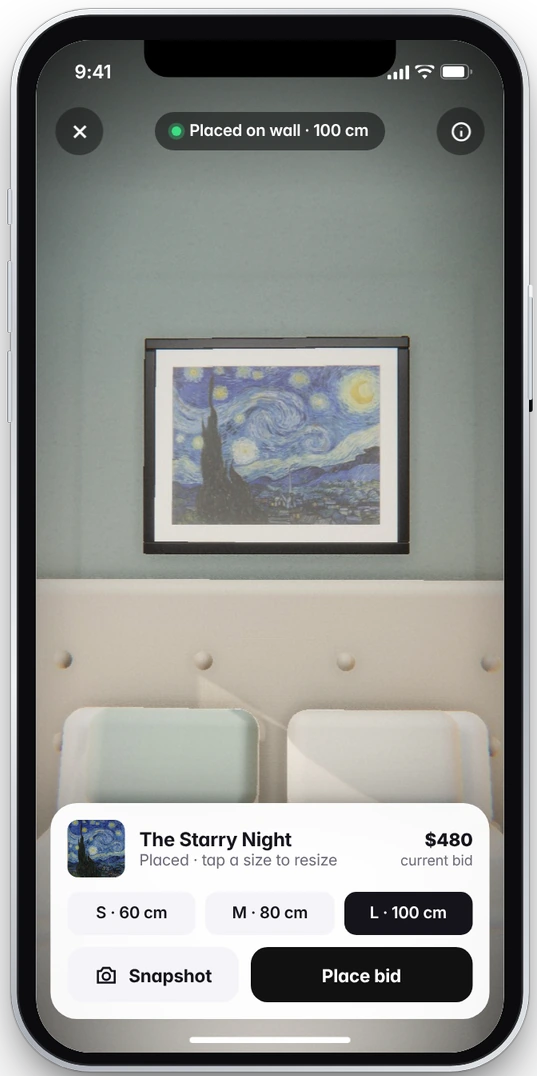
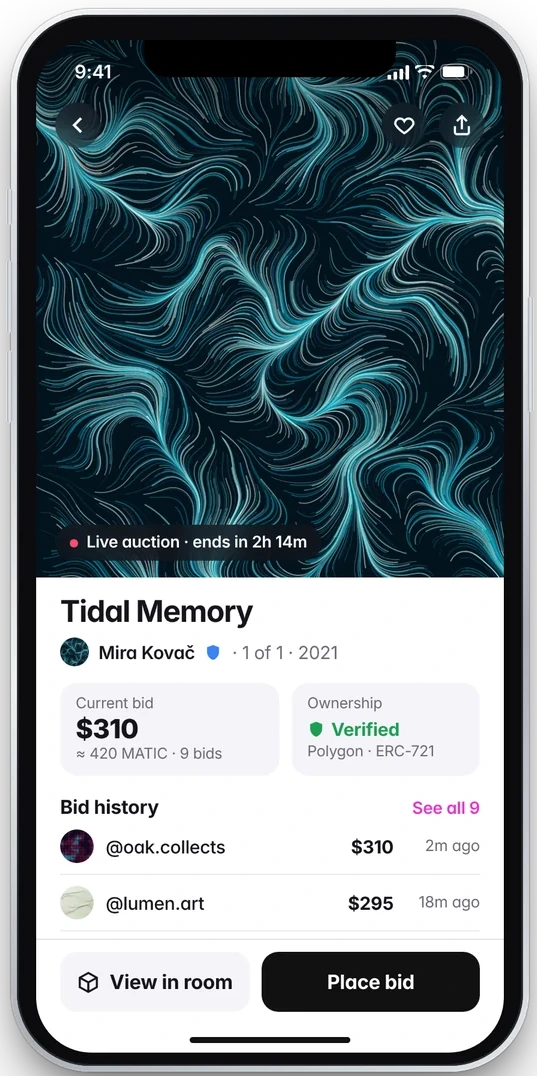
We built on Apple’s ARKit so collectors could place a piece on their own wall at real size before bidding. Later we added Object Capture so artists could scan physical sculptures into 3D and show those in AR too.
Ownership on a blockchain
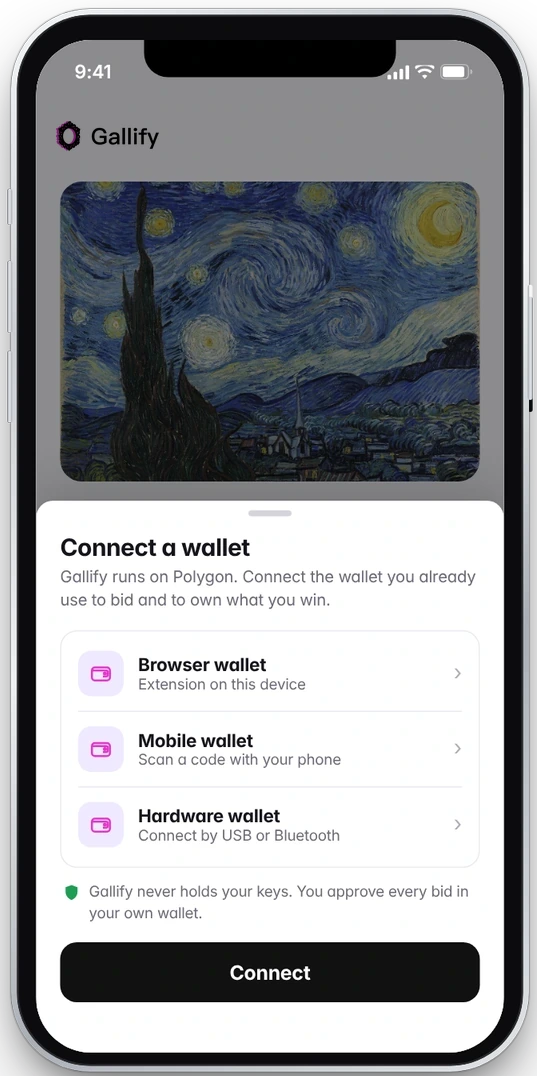
Purchases are tokens on Polygon (an ERC-721 contract written in Solidity) with wallet connect, so a purchase meant verifiable ownership. Polygon’s low fees and fast confirmation suited small first purchases by new collectors.
Collectors keep their own keys
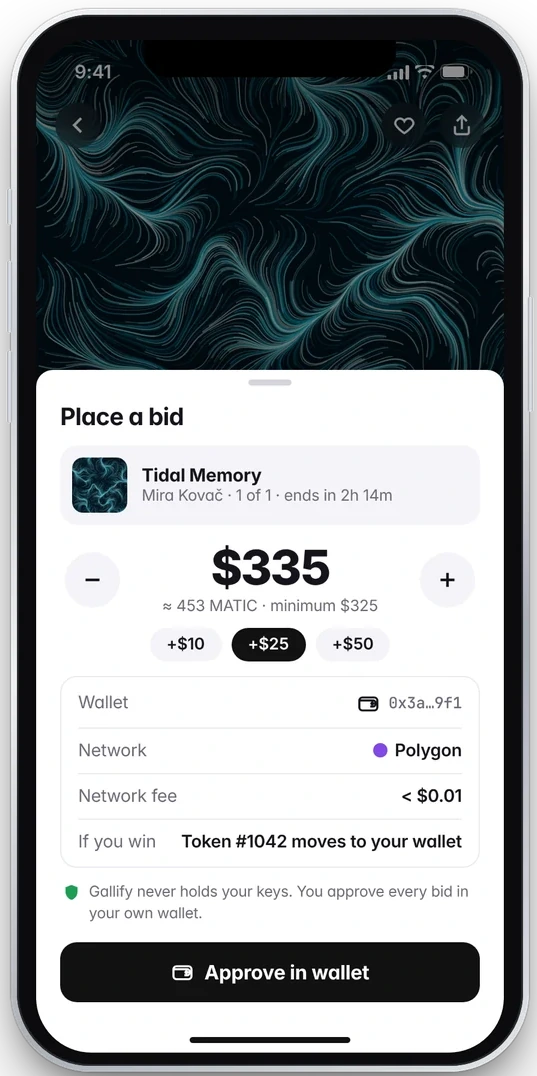
Bids and purchases are approved in the collector’s own wallet. Gallify never holds anyone’s keys, which meant fewer security obligations for us and more trust for them.
Lower the bar for artists
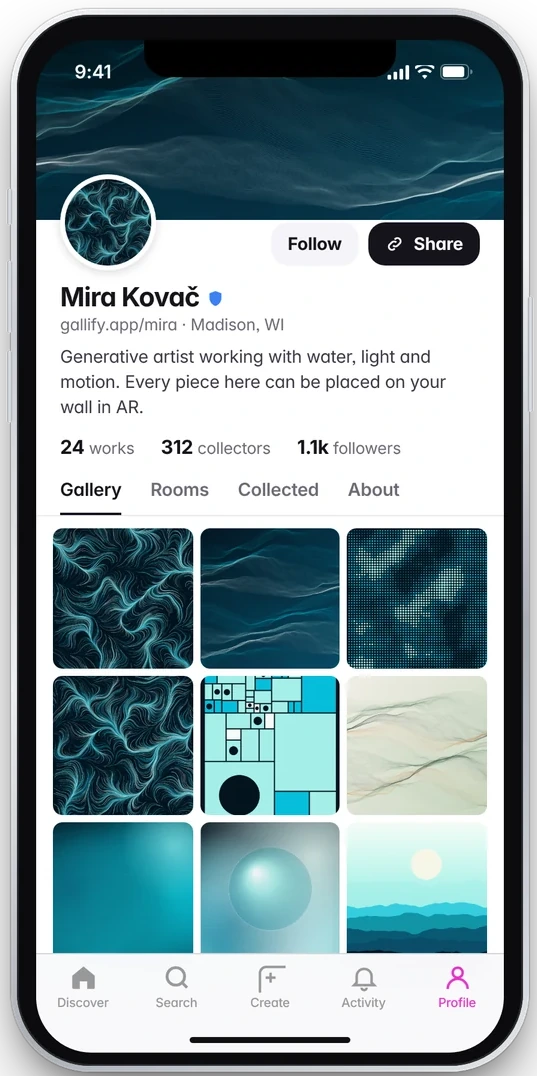
Publishing a gallery from a phone takes minutes: upload images or capture a 3D piece, mint the work as a one-of-one, and share one link.
- iOS appAuctions, discovery, galleries and profiles, built in Swift for iPhone
- AR layerARKit places any piece on a wall at real size; Object Capture turns physical work into 3D
- OwnershipSolidity smart contracts on Polygon issue each piece as a one-of-one token
- WalletThe collector approves every bid and purchase in their own wallet
Illustrative.
The recommender
I led the AI recommender for listings. Collectors arrived without a clear idea of what they wanted, and every artist wanted to be seen, so a feed that put the right piece in front of the right person was the most valuable thing we could build.
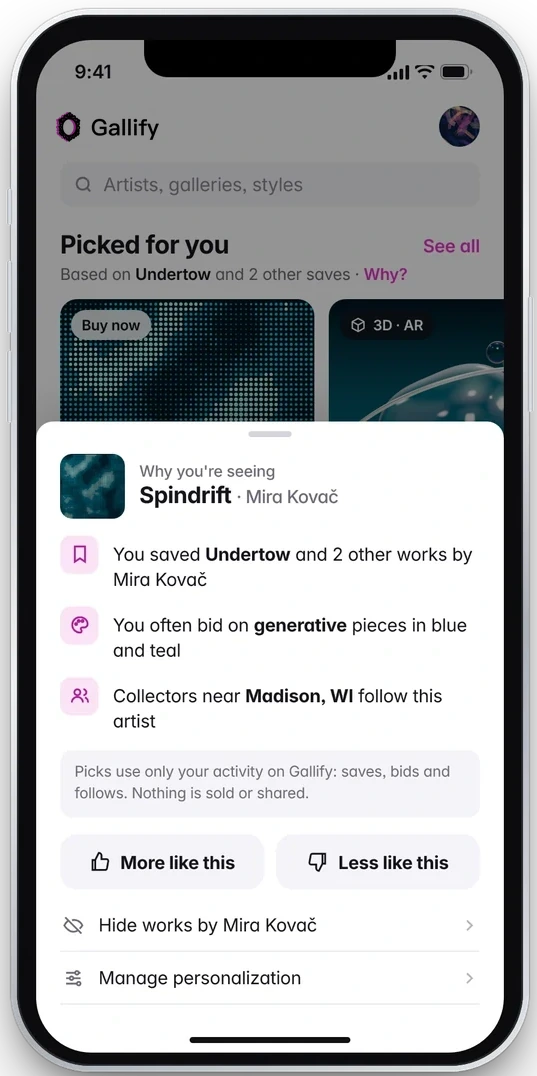
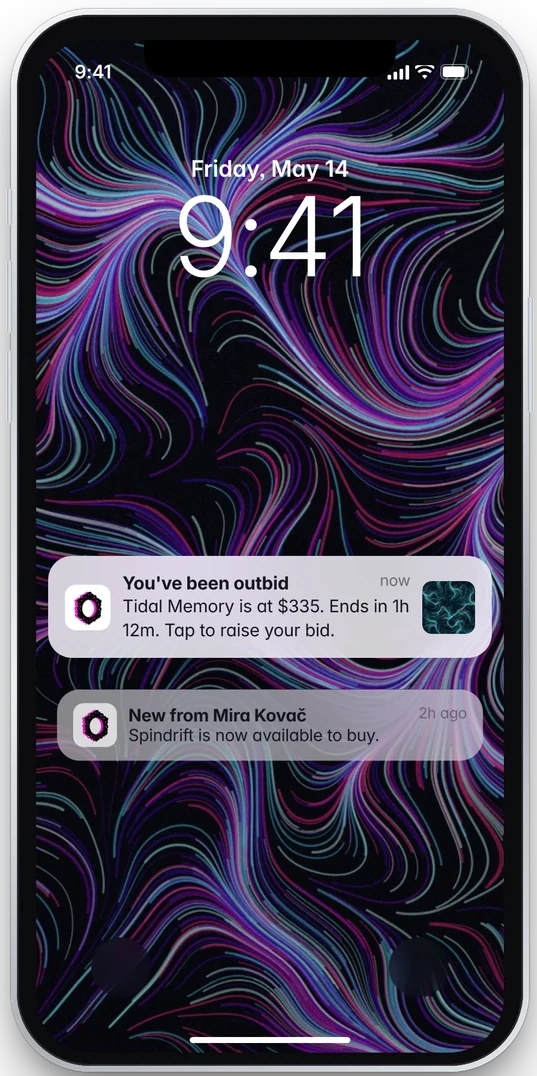
It ranked live auctions and listings for each collector from their browsing behavior (what they had viewed, saved, bid on and bought) and from how visually similar pieces were, plus each piece’s style, medium and artist. New collectors picked a few styles they liked first so the feed wasn’t empty on day one. Each pick had a reason behind it, and collectors could ask for more or less of something, or hide an artist. We measured the feed against our previous ordering, looking at click-through and at average order value rather than time in the app. Click-through rose 30% and average order value 20%.
Illustrative.
How the recommender worked
Signals come from what a collector does (what they view, save, bid on and buy), from how visually similar pieces are, and from each piece’s style, medium and artist. New collectors pick a few styles first, so the feed is never empty on day one.
The ranker scores live auctions and listings for each collector and reorders them as they browse. Every pick comes with a reason, such as works you saved or pieces you bid on, and controls to see more, see less, hide that artist or manage personalization. Picks use only a collector’s own activity on Gallify.
Two things fed back into the ranking: what collectors did with the controls, and the measured results. We measured against the previous feed on click-through and average order value, which rose 30% and 20%.
Auto-tagging
We also built computer-vision auto-tagging for 2D and AR/VR artwork, so artists no longer had to tag every piece by hand. It cut the time to list a piece by 60% and lifted search conversion by 25%.
Trade-offs I'd flag
Two of our biggest bets were also our riskiest, and each one cost us something.
AR. It was the feature people remembered, and nothing else felt like our product. It was also a big engineering investment that only paid off if enough collectors cared about seeing a piece in their room. People loved the moment. We never got clear evidence that it made them buy.
Blockchain. On-chain ownership solved the real problem of proving a piece is yours. It also added friction. New collectors had to set up a wallet before they could bid, which is a lot to ask before they’ve seen a single piece they love. We kept fees low on Polygon and made the wallet step as clear as we could, but it still cost us growth.
Team, results and the shutdown
Growth
Gallify grew to more than 7,500 users, 2,500+ artists and 5,000+ buyers, at about 15% a month, mostly organically, and we secured investment from a Midwest venture capital firm.
Running the team
By our busiest period we had six projects running across four sub-teams, 10+ people in all. I was Scrum Master and also the main technical decision-maker, which meant setting product priorities and engineering standards. Delivery was unreliable when I took it on. Here’s what I changed.
- Rhythm. I set up regular sprints and one-on-ones, so problems surfaced in a week instead of at the deadline.
- Standards. I wrote down engineering standards, including what “done” meant, so quality didn’t depend on who was reviewing.
- Hiring. I ran the whole process, from sourcing to onboarding, as the team grew from 3 to 10+.
- Onboarding. I documented the codebase and the way we worked so new engineers could contribute sooner.
| Delivery measure | Result |
|---|---|
| On-time delivery | From about 60% to 85% |
| Average bug resolution time | About 35% faster |
| Team velocity | About 30% higher, with scope and budget within 10% of projections |
| Time to productivity for new engineers | About 25% shorter |
| Active projects | All 6 delivered on schedule, within 8% of estimates on average; production incidents under 2% of deployments |
Over five years we shipped three major releases. They covered marketplace transactions on the blockchain, the AR gallery experience and the iOS app itself, and we designed, built and launched the platform ahead of schedule. The recommender gave us the 30% and 20% lifts described above.
| Outcome | Result |
|---|---|
| Users | 7,500+: 2,500+ artists and 5,000+ buyers |
| Growth | About 15% month over month, mostly organic |
| Investment | Secured from a Midwest venture capital firm |
| Click-through from recommendations | +30% |
| Average order value | +20% |
| Time to list a pieceAuto-tagging | −60% |
| Search conversionAuto-tagging | +25% |
| Major releases | 3+: marketplace transactions, AR galleries, iOS |
| Platform | Designed, built and launched ahead of schedule |
| Business | Wound down in 2021 as we broadened from digital art to public art with CODAworx |
Winding it down
The product worked. People used the AR view, the recommendations measurably moved sales, and the user base kept growing. In 2021 we wound the company down because we decided to broaden from digital art to public art, which became a new venture with CODAworx: CODAmarket. I recommended the move. Closing the company carefully, with its people, code and commitments, was part of the job too.
Before deciding I looked at four things: whether the people who tried Gallify came back, whether new collectors kept arriving without us pushing, whether we could afford another year of the same bet, and whether the team was still excited about it. Weighing those against the larger market in public art that our CODAworx partnership had opened up, I recommended that we close Gallify and put our effort there. I told the team directly, did what I could for the people who had put years into it, and made the app’s code public so the work could still be seen.
What I'd do differently
- We built AR and blockchain ownership before we had proof that enough collectors wanted them. Today I’d test demand first with something much cheaper, like a landing page, a handful of artists and a manual version of the experience.
- Our delivery numbers improved a lot, and they still didn’t tell us whether the business was working. I now decide up front which retention number would justify continuing, and I look at it every month.
- Moving to the bigger market was the right decision. I would make it sooner.
- Telling users why a piece is shown, and letting them change it, was cheap to build and gave us a clearer signal than clicks alone. I’d do it from the start on any recommender.