Overview
Custom jewelry is expensive mostly because of the people between you and the person who makes it. Jewelers hold the relationships with manufacturers and designers, and they mark prices up to cover that, plus the store and the hours of consulting that custom work takes. A buyer can’t tell whether a price is fair, so many don’t trust the process, and custom pieces stay out of reach for anyone who isn’t already wealthy. I described Goldsmith as the Warby Parker of custom jewelry.
I wrote the product plan, the research plan and the business model, built the financial model, presented the plan to investors in December 2024, and delivered the platform in 12 weeks.
The platform has not been released to the public, so there are no usage numbers.
Problem and research
Three things about the market stood out. The first is price: I found that custom work is marked up by 200% to 500%, and the buyer sees only the final number. The second is trust: most people don’t buy custom jewelry often enough to know what a fair price looks like, so they either overpay or give up. The third is access: a small jeweler without a strong network of verified manufacturers, or without expensive hardware for 3D design, can’t compete on speed or choice.
How big is it?
Nobody agrees on the size of the custom slice. Published estimates of all jewelry sales in 2024 sit at about $367 billion to $371 billion. Estimates for custom jewelry services alone run from about $1.09 billion to $3.63 billion depending on the publisher, and broader definitions of customized jewelry reach $31.8 billion to $36.2 billion. The gap comes from what each report counts, so I treated the range as a reason to size the opportunity from the bottom up, using manufacturers and buyers I could actually reach, and not from a market report.
| Measure (2024) | Estimate | What it counts |
|---|---|---|
| All jewelry sales | $367B to $371B | Two aggregator estimates of global jewelry revenue |
| Custom jewelry services | $1.09B to $3.63B | Services only, and the range depends on the publisher |
| Customized jewelry products | $31.8B to $36.2B | Broader definition that includes made to order products |
Who it's for
The business has three sides, and each one has a different reason to use it. I wrote them down early because they decide what the product has to do.
Buyers
People who want a custom piece without knowing how to design one. They want to describe what they like, see it, and know the price they’re given is fair. They will pay for quality but want to compare more than one offer.
Jewelers and designers
Small and mid size shops without powerful computers or a deep network of verified manufacturers. They want faster designs, a design department that costs less, and a shorter route to production.
Manufacturers
Makers who want custom work to fill capacity. Custom jewelry takes a lot of manual effort to conceive, and leads that arrive with a finished design and a specification make it more profitable.
How I planned to test the idea
I wrote a customer discovery interview guide. It starts from a stated problem and value hypothesis, then asks buyers ten questions: how often they buy, what hurts most about custom jewelry, how much they trust a jeweler’s price on a 1 to 10 scale, whether they would design with natural language, whether they would choose a piece from a 3D preview, and how long they would wait. I built it so the answers would turn into simple probability models and descriptive statistics, not a pile of quotes.
I don’t have interview results to report, and I won’t imply that I do. The guide is the work product.
What already exists
I looked at the tools jewelers use to design. They are all CAD software, and the closest existing route to a finished piece belongs to one company: Gemvision’s MatrixGold is owned by Stuller, which also makes custom jewelry from submitted designs, but only for businesses with a resale account.
| Tool | What it is | Who can use it |
|---|---|---|
| MatrixGold (Gemvision, a Stuller company) | 3D jewelry design software. Designs can go to Stuller’s CAD/CAM service for casting and finishing. | Jewelers with a Stuller resale account |
| RhinoGold | Jewelry specific version of the general purpose Rhino 3D modeler | Paid software, mostly trained designers |
| JewelCAD Pro | Proprietary jewelry CAD, listed for Windows | Paid software, mostly trained designers |
| Blender | Free, open source mesh modeler that needs add-ons for jewelry work | Anyone willing to learn it |
In my 2024 review none of these paired design from a text description with a marketplace where manufacturers compete on the same file. That is the gap I built Goldsmith around. It is a claim from my review, not a survey of every tool on the market.
Solution
Goldsmith has two parts, a design tool and a marketplace, and they depend on each other. The tool creates the design a manufacturer can quote on. The marketplace turns that design into a real piece at a price the buyer can compare.
How a buyer uses it
- 1DescribeThe buyer writes what they want in plain language.
- 2GenerateThe platform creates candidate 3D designs using generative CAD on open source design software.
- 3RefineThe buyer iterates, or a jeweler with the full tool edits by hand on cloud GPUs.
- 4Request quotesThe design goes to manufacturers, who quote through a request for quotation.
- 5Try it onThe buyer receives 3D printed models of their top candidates.
- 6OrderThe buyer picks a final design and expects the finished piece in about three weeks. That is the plan's expectation, not a measured time.
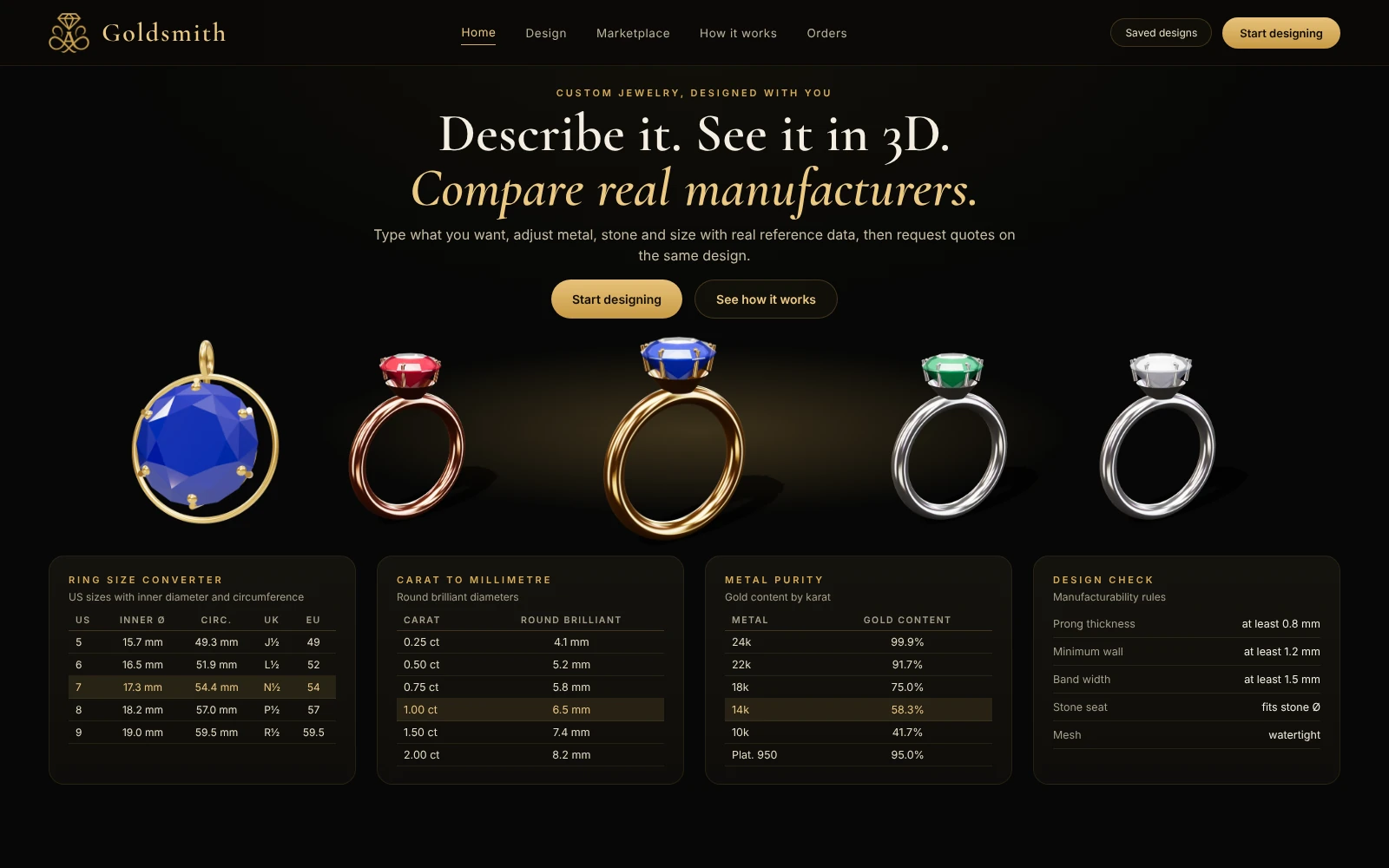
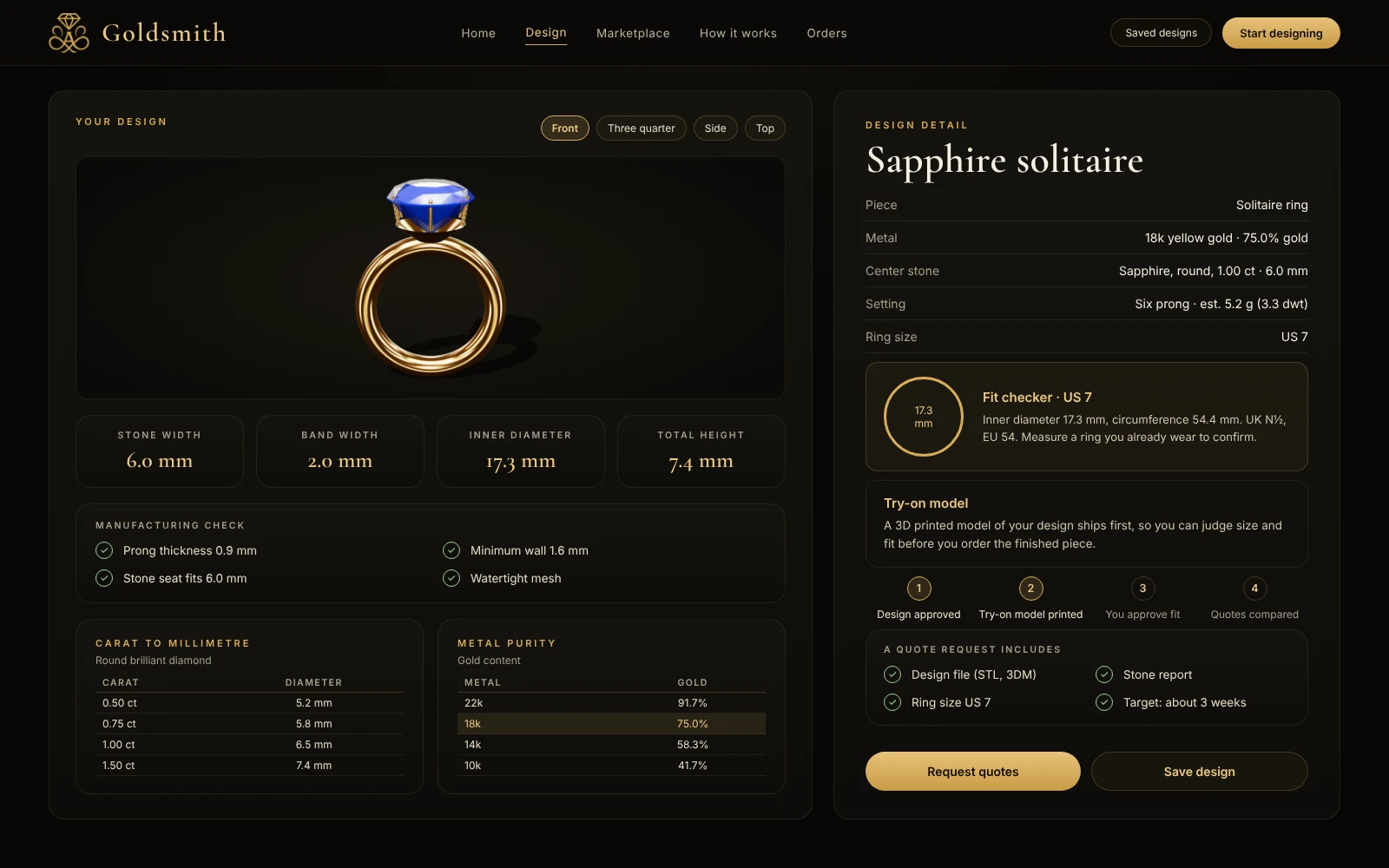
Illustrative.
Built in reference tools
Most of the value in a design tool is the small facts a buyer or jeweler would otherwise look up elsewhere. The tool keeps three reference tables one click away, so the design, the stone and the size always agree. These are standard industry reference values, not figures from the plan.
| US ring size | Inner diameter | Circumference | UK | EU |
|---|---|---|---|---|
| 5 | 15.7 mm | 49.3 mm | J½ | 49 |
| 6 | 16.5 mm | 51.9 mm | L½ | 52 |
| 7 | 17.3 mm | 54.4 mm | N½ | 54 |
| 8 | 18.2 mm | 57.0 mm | P½ | 57 |
| 9 | 19.0 mm | 59.5 mm | R½ | 59.5 |
| Round brilliant | Diameter |
|---|---|
| 0.50 ct | 5.2 mm |
| 0.75 ct | 5.8 mm |
| 1.00 ct | 6.5 mm |
| 1.50 ct | 7.4 mm |
| 2.00 ct | 8.2 mm |
| Metal | Gold or platinum content |
|---|---|
| 24k gold | 99.9% |
| 22k gold | 91.7% |
| 18k gold | 75.0% |
| 14k gold | 58.3% |
| Platinum 950 | 95.0% |
A design check reads the same numbers. The rules below are example starting values. Each manufacturer’s own limits replace them.
| Example rule | Starting value | Why it matters |
|---|---|---|
| Prong thickness | At least 0.8 mm | Thin prongs bend or break when the stone is set |
| Minimum wall | At least 1.2 mm | Thin walls can fail in casting |
| Band width | At least 1.5 mm | Keeps the shank strong enough to resize |
| Stone seat | Matches the stone diameter | A loose seat means a loose stone |
| Mesh | Watertight | Printers and casters need a closed solid |
The supply side is real
The marketplace only works if manufacturers can make what the tool designs. I checked who actually offers the services the platform would route to, and every company below publishes what it does. None of them is a partner, and none has quoted anything.
| Manufacturer | Where | What it publishes |
|---|---|---|
| Stuller | Lafayette, Louisiana | CAD/CAM design, casting, finishing and stone setting. Says it sends a quote and render in 24 to 48 hours and aims to finish custom orders in 10 to 15 business days. Requires a resale account. |
| Hoover & Strong | Richmond, Virginia | Contract casting and CAM wax printing, with recycled (Harmony) or Fairmined metals. Lists CAD service at $75 an hour and 3D printing from $31.50. |
| Richline Group | Corporate group, owns Rio Grande of Albuquerque, New Mexico | Precious metal jewelry and materials manufacturer. Responsible Jewellery Council certified, with Rio Grande inside the certificate scope. |
How the platform works
This is the platform I built in 12 weeks. Buyers and small and mid-size jewelers are on one side and verified manufacturers, the supply side it routes to, are on the other, with the design engine and reference data in between.
A buyer describes a piece in plain language. The platform creates candidate 3D designs with a language model and generative CAD on open source design software. The buyer refines them, or a jeweler with the full tool edits by hand on cloud GPUs. Reference tables for ring size, carat to millimetre and metal purity, and manufacturing rule checks, keep the design realistic. The rules are example starting values that each manufacturer’s own limits replace.
The design then goes to verified manufacturers, who share business documents before they can bid and show certifications where held. They quote through a request for quotation with estimated cost, the final design and specifications. The buyer compares the quotes, receives 3D printed models of the top candidates to try, picks one, and expects the finished piece in about three weeks. That timing is the plan’s expectation, not a measured result.
Two loops matter. Design checks send fixes back into the model, and quotes and try-on results send the buyer back to refine the design. Underneath sit payments, and training the models on data that is not someone else’s design, with a way for a buyer to protect a design they create.
How I delivered it in 12 weeks
I kept the build to 12 weeks by deciding early what not to build. I used open source design software instead of writing a modeler, and put the AI on top of it. The full tool runs on cloud GPUs, so no jeweler needs special hardware. The reference tables and manufacturing rules are data the design is checked against, and manufacturers replace the example limits with their own. The design file is the one thing every manufacturer quotes on, so there is no custom work per quote.
- Build on, don’t build from scratch. Open source CAD and generative CAD did the heavy lifting.
- Check as you design. Reference data and rule checks catch problems before a manufacturer sees the file.
- One file, many quotes. Manufacturers quote on the same design, so offers compare fairly.
- Verify before they bid. Manufacturers share business documents first, which keeps the marketplace trustworthy.
Decisions I made
Open source design software underneath
I built on open source CAD so one person could move quickly instead of writing a modeler from scratch. The AI work sits on top of it.
Not chosen: Licensing or building a proprietary modeler. It would have used most of the 12 weeks before anyone saw a design.
Train on data that isn't someone else's design
I set the rule that models are trained on non IP data and that a buyer can protect any design they create. A jeweler’s catalog is their livelihood, and a tool that copies it would not get used by the people I needed.
Not chosen: Training on scraped catalogs because it would have been faster.
Verify manufacturers before they can bid
Manufacturers share business documentation before they can quote, and certifications such as the Responsible Jewellery Council’s are shown where a company holds one. That is what makes a buyer willing to compare offers from strangers.
Not chosen: An open marketplace where anyone can list, which is easier to grow and harder to trust.
Document the stone, not just the setting
A center stone should come with a lab grading report where it is eligible. GIA, for example, grades and reports on stones; it does not certify manufacturers, so the platform keeps the two separate.
Not chosen: Letting a listing imply that a manufacturer is ‘GIA certified’.
Cloud GPUs for the tools
Jewelers and designers get the full tool on cloud GPUs, so a small shop doesn’t need expensive hardware to compete.
Not chosen: A local install only, which would have kept out the shops the product was built for.
Let a buyer hold the design first
A 3D printed model of the top candidates lets a buyer judge scale and fit, and it makes the three week wait easier to accept because they have already seen the thing.
Not chosen: Renders only, which are cheaper and don’t answer whether the buyer will commit.
How it makes money
The plan had five revenue streams, each tied to a different customer. They were not meant to start at once.
| Revenue stream | Who pays | What the plan says |
|---|---|---|
| Software licences and subscriptions | Jewelers and designers | Licences from $5,000 a year for on premise use, cloud subscriptions from $8,000 a year |
| Support contracts | Business customers | Design support engineers and technical support engineers |
| Platform fees | Jewelers, manufacturers and power users | A monthly fee based on usage and premium functions |
| Sponsored listings | Manufacturers | A fee to appear as sponsored when buyers compare quotes |
| Transaction fee | Marketplace orders | A fee on each completed order |
How I planned to reach each side
Buyers come in through the website and social media. Jewelers and manufacturers are reached through LinkedIn, trade expos, follow up calls and account managers, with HubSpot connecting the channels. I expected social media outreach to be the cheapest per contact and account managers to matter most for jewelers and manufacturers, since those are relationships, not clicks.
What I would release first
I wouldn’t release the whole platform at once. A first release needs to answer one question: will a buyer pick a final design from a 3D preview and wait about three weeks for it? So I would limit it to a small run.
- Design. Text to 3D candidates for one category, such as rings, with a small catalog of styles.
- Quotes. A request for quotation sent by hand to a few manufacturers that publish their services.
- Try on. 3D printed models of the top candidates for each buyer.
- Measure. Whether buyers commit, how long they take, and what they would pay.
Where it stands
Goldsmith went from a concept to a business model, a financial model, an investor pitch and a working platform in 12 weeks. It has not been released to the public, so I have no usage or revenue to report, and every figure in the plan below is a target, not an outcome. I would rather say that plainly than dress up targets as results.
What the plan targeted
At the December 2024 pitch I presented a plan for a seed round. These are targets from that plan, not results.
| Stage | Target in the plan |
|---|---|
| Year one | Public beta with 1,000 users and 20 manufacturers, and about $500K in revenue |
| Year two | 5,000+ users and partnerships with 50 manufacturers, and about $2M in revenue |
| Year three | 10,000+ users and global manufacturing partnerships, $5M+ in revenue at 90% retention |
| Long term | Establish Goldsmith as the leading custom jewelry design platform, with revenue growing past $20M a year |
The assumption to test first
The plan rests on one behavior. Buyers will choose a final design from a 3D preview and wait about three weeks for the finished piece. If they won’t, the cost advantage disappears, because a jeweler’s fitting room is the thing I was trying to replace. So before a public release I would run the small version above with a few manufacturers and a few dozen real buyers.
Before a run like that I would write down what counts as a pass. The criteria below are proposals I would set in advance, not findings.
| What I'd measure | Why it matters | A pass I'd set before starting |
|---|---|---|
| Share of buyers who pick a final design from a 3D preview | It tests the core behavior directly | A clear majority of buyers who reach the preview stage |
| Buyers who accept a three week wait | The timeline is part of the promise | Most buyers who pick a design go on to order |
| Quote competitiveness | It tests the claim that buyers get a better deal | Quotes beat what the same buyer was quoted by a jeweler |
| Manufacturer response and win rate | Without supply the marketplace has nothing to sell | Manufacturers respond to most requests and win some |
The two priorities I set
My business model work ended with two priorities to validate, and I still think they were right.
Customer segments
I believed there were more segments than I had found and that some deserved more emphasis, depending on which side of the network they sat. The plan was to map the market for both sides and rank segments by how well they fit the product and the outreach.
Key resources and IP
Whether AI generated designs can be protected, and how the data behind the models is governed, was an open legal question. The plan was to research IP law, data governance, open source model datasets and their licensing before training anything.
What I took from it
- Decide what not to build. Open source CAD, cloud GPUs and reference data are why the platform got built in 12 weeks.
- Say what the stage is. A pitch can carry a plan without pretending the plan is a result. Investors trust a founder who keeps those apart.
- Pick the assumption that can kill the idea. For Goldsmith it was whether buyers will commit from a 3D preview. I would test it before a public release.
- A marketplace has two cold starts. Buyers won’t come without manufacturers and manufacturers won’t come without buyers. Verification, and handling the first quotes by hand, are how I would start both.
- Treat legal questions as product questions. Who owns an AI generated design shapes what data can be used for training and what can be promised to a buyer.
- Match the funding stage to the evidence. Before there is revenue, the honest ask is an early round such as pre seed or seed, sized to the test above.
What I'd do differently
- Put a rough version in front of real buyers and manufacturers before the pitch, so the plan had at least one real data point behind it.
- Start the IP and data governance research in the first weeks, because it constrains the training data and the promise to a buyer.
- Run the three week promise as an experiment before releasing the platform that depends on it.