Platform · Discharge date prediction
See each patient's likely discharge date days ahead
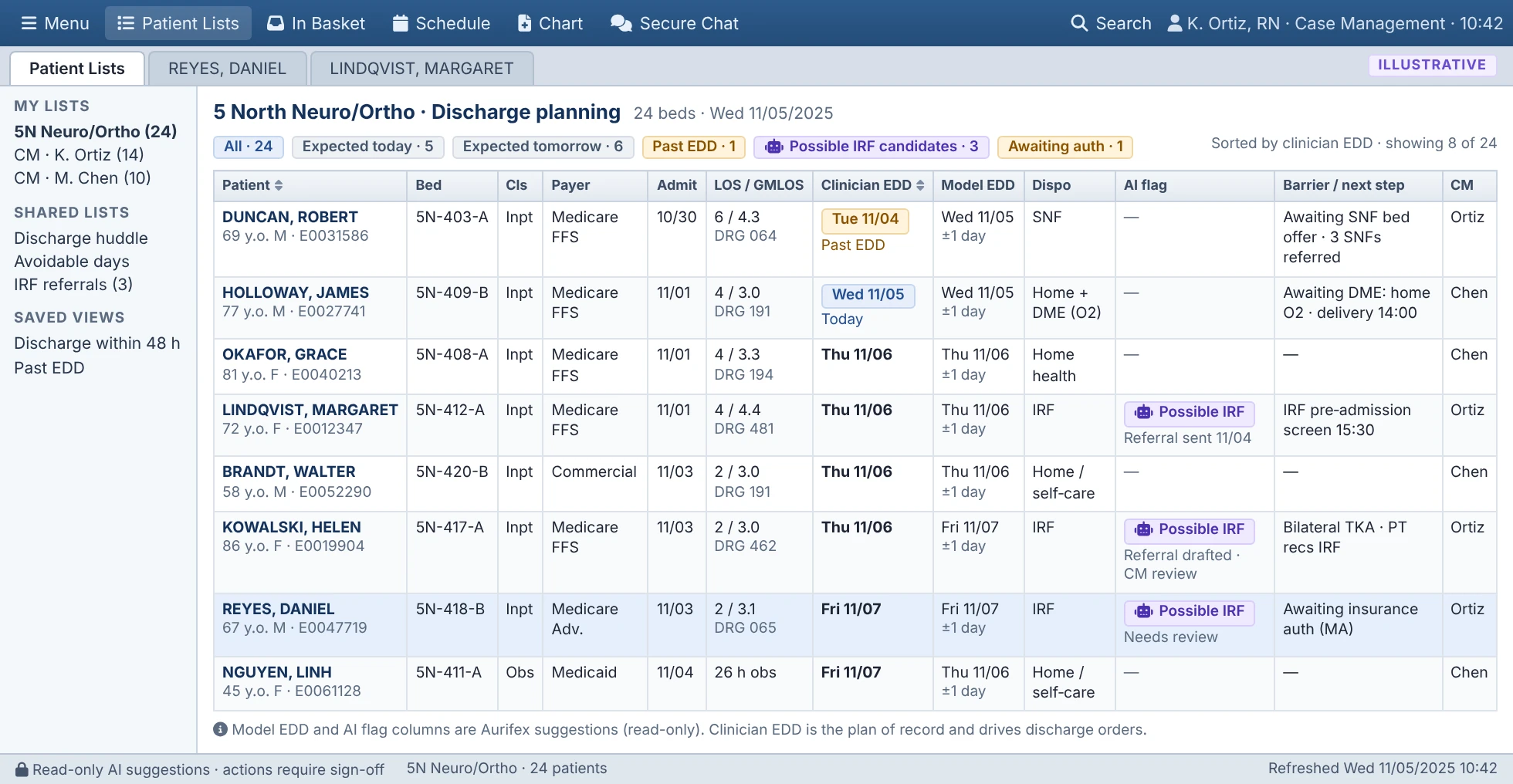
A machine learning model predicts each patient's expected discharge date and likely next place of care, and shows both beside the date your team set.
What it predicts
Planning a discharge takes days. The post-acute bed, the payer authorization and the equipment all need lead time, so the date has to be known before it arrives.
For each patient on the unit, Aurifex shows three things in the case-management worklist.
- Model expected discharge date (EDD). The day the patient is likely to be ready to leave, shown with a one-day range.
- Anticipated disposition. The likely next place of care: home or self-care, home health, skilled nursing facility (SNF), inpatient rehabilitation facility (IRF) or long-term acute care hospital (LTACH).
- Length of stay against expected. Days in the hospital so far next to the geometric mean length of stay (GMLOS) for the working DRG, so outliers stand out early.
How the model works
The prediction comes from a gradient-boosted model fit on your hospital's own history and checked on held-out months before go-live. It reads data your Epic system already has, through standard interfaces.
| Signal | Examples |
|---|---|
| Admission | Admission source and time, inpatient or observation status, unit and service |
| Clinical picture | Working DRG and GMLOS, diagnoses, procedures, vital-sign and lab trends |
| Function and therapy | PT and OT evaluations and recommendations, mobility scores such as AM-PAC 6-Clicks, prior level of function |
| Care progression | New orders, consults, level-of-care changes and pending tests |
| Discharge planning | Payer, documented barriers and the clinician-set expected discharge date |
The date updates as the chart changes, such as a new therapy evaluation, a resolved barrier or a change in level of care. Before go-live, the model is validated on your own hospital's history so its accuracy is measured on your patients, not ours. See how a pilot runs.
Model date and clinician date, side by side
The clinician-set expected discharge date stays the date of record. The model's date sits next to it and never overwrites it, and the worklist shows who set each date and when.
When the two dates disagree by more than a day, that patient is worth a conversation in the morning huddle. Sometimes the model has spotted a barrier early. Sometimes the team knows something the chart doesn't say yet. Either way, the team decides.
Accuracy and monitoring
In testing on 25,000 de-identified historical admissions held out from training, the model's expected discharge date was within one day of the actual discharge date for at least 85% of them, with a mean absolute error of 0.6 days. It predicted the next place of care correctly 82% of the time. Before go-live at your hospital, it's measured again on your own history.
Compared with what you have today
During validation at each new hospital, the model is compared on the same patients with the clinician-set expected discharge date and with any estimate your EHR already produces. You see the share within one day and the average error in days for each, overall and by unit, before deciding to go live.
Accuracy is tracked after go-live, not just at launch.
- Weekly by unit. The share of discharges within one day, with misses reviewed for patterns.
- Across patient groups. The same measure by payer, age band and other groups, as part of our fairness checks under ACA Section 1557.
- Reviewed changes. Retraining is reviewed, versioned and can be rolled back. A new version goes live only after it matches or beats the current one on your data.
What it never does
- It doesn't change the clinician-set expected discharge date.
- It doesn't write a discharge order or decide where a patient goes.
- It doesn't contact patients, families or facilities.
The model date is a planning signal. Discharge readiness is a clinical decision, and it stays with the care team.
Questions
Do clinicians have to enter anything new?
No. The model uses data that's already in the chart. Teams keep setting their own expected discharge date the way they do today.
Does it work for observation patients?
Yes. Observation and inpatient status are both inputs, and the worklist shows hours in observation for those patients.
What happens when the model is wrong?
The clinician date stays the date of record, so a wrong model date doesn't change the plan. Misses are reviewed weekly and feed the next model version.

See Aurifex on your own discharge workflow
We'll walk through your worklist, a drafted referral and how a pilot would be measured on your units.