Trust and AI safety
How Aurifex keeps a person in charge
Aurifex predicts and drafts; a named person approves anything that leaves it.
For your AI governance committee
| Intended use |
|
|---|---|
| Human approval | Nothing is sent, ordered or filed to the chart until a named person approves it |
| Evaluation |
|
| Fairness |
|
| Adversarial testing | A 1,200-case automated evaluation suite, with 40 of 40 prompt-injection tests passed. Scope: direct and indirect injection through note text, instruction override and data-exfiltration attempts |
| Regulatory | Designed as non-device clinical decision support under the 21st Century Cures Act criteria; no FDA clearance sought |
| Security |
|
| Your controls |
|
Your controls
- Pause any feature at any time. You can pause a flag, a draft type or the whole product, and it takes effect immediately.
- Approve every release. No model or prompt release goes live at your hospital without your written approval. A change in the language-model version counts as a release.
- Roll back within one business day. Any release can be rolled back to the previous version.
- Set the alert budget. Your team chooses the notification channel, the threshold and a cap on pended consults per attending.
A person approves everything that leaves Aurifex
Nothing is sent to a facility, ordered or filed to the chart until a named person approves it.
- Aurifex draftsA summary, referral packet or consult, with a source for every statement
- A person reviewsThe case manager or physician opens the draft, checks the sources and edits
- A person approvesOr rejects it. It goes out under their name
- Epic or the facilityFiled, signed or sent, and logged in the audit trail
What Aurifex does, and what a person does
| Aurifex does | A person does |
|---|---|
| Predicts an expected discharge date and next place of care | Sets the expected discharge date of record and decides discharge readiness |
| Flags possible inpatient rehab (IRF) candidates | Determines candidacy, with the attending and PM&R |
| Drafts the PM&R consult as a pended order | The attending reviews, edits and signs, or declines |
| Drafts the referral packet and the IRF choice list | The case manager reviews, edits and sends to the facilities the patient chose |
| Lists barriers and suggests next steps | The unit team assigns owners and acts |
Alert burden
No interruptive alerts, pages or pop-ups to bedside nurses or physicians. Overdue barriers reach their owner in a digest (how barriers are tracked). Flag, consult and notification counts are reviewed weekly.
Sources on every statement, and clinician review
Each clinical sentence in a summary, packet or consult must cite the note, flowsheet, order or result it came from. An automated check removes statements without a source before review. In testing, 1.5% of reviewed statements were unsupported after the automated check.
Diagnoses come only from the problem list and documented assessments. Critical fields such as allergies, code status and isolation are checked against the chart before a packet can be sent.
Guarding against over-reliance
- Sources one click away. Reviewers can check any statement against its source without leaving the draft.
- Open before sending. A draft can't be sent or signed until the reviewer has opened it.
- Edit rates reported. Edit rates for each reviewer, including drafts approved with no edits, are reported to you during a pilot. If a reviewer approves nearly every draft unedited, that prompts a review with you.
Ongoing clinician review
After launch, case managers, attendings and physiatrists review a weekly sample of drafts and flags, with patients hidden, and record their call, the finding and its severity. High-severity findings come to us the same day.
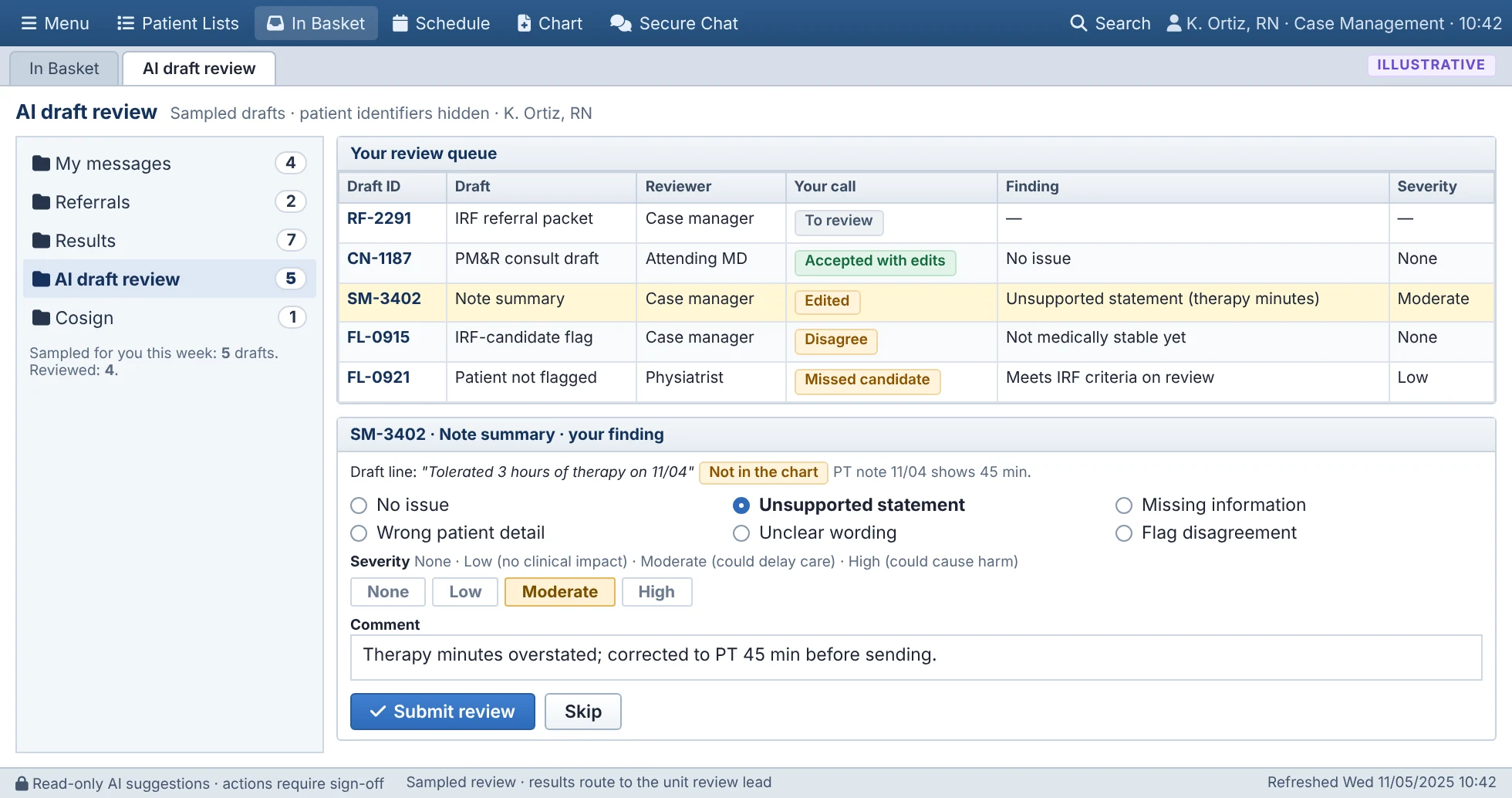
Launch gates and monitoring
Before a model or prompt reaches clinicians, it's tested against an evaluation set and must pass every gate. The levels are set with you at kickoff and written into the pilot plan.
| Gate | Requirement |
|---|---|
| Source on every clinical sentence | Enforced |
| Hallucination rate (per statement) | 2% or less to start; the final level is agreed with you and written into the pilot plan |
| Critical omissions: allergies, code status, isolation | None allowed through to sending |
| Discharge-date accuracy and flag agreement | At or above the current version, overall and for each patient group checked |
| Balancing measures | 30-day readmissions no more than 1 point above your baseline to start; the final margin is set in the pilot plan; if crossed, the feature pauses |
| Go-live sign-off | You and we both sign off before clinicians see anything |
If a gate fails in silent mode, silent mode is extended or the pilot stops. After go-live the same measures are monitored weekly, and a feature that drifts below the agreed level pauses until a reviewed fix is released (starting trigger: a 5-point drop in within-one-day accuracy over 2 weeks). Nothing changes in production automatically.
Fairness across patient groups
ACA Section 1557's nondiscrimination rule applies to patient-care decision support tools. We check discharge-date accuracy, flag rates and flag agreement across patient groups, including traditional Medicare and Medicare Advantage, dual-eligible patients, race and ethnicity where recorded, patients 85 and older, and patients with a disability. Subgroup results are shared with your quality and compliance teams before go-live and at the end of a pilot. If a gap above the agreed threshold appears, we own the investigation and the fix, and you see the corrective action before the next release.
If something goes wrong
- Report it. Mark the draft in review, or email info@aurifexhealthcare.com with "Concern" in the subject, for any safety, privacy, security or fairness issue. We reply within one business day. Please don't include patient information.
- We tell you. If a model error reached a clinician, we notify you within 24 hours, with what happened and what we changed.
- Responsibility stays clinical. The clinician of record keeps responsibility for every clinical decision. Aurifex is decision support; it isn't a medical device and it doesn't act on its own.
- Safety events. Clinical safety events follow your hospital's own reporting process, and we join the review.
How the AI works
A fuller description in the HTI-1 source-attribute format is available on request.
The model description
| Discharge prediction | Rehab flags and drafts | |
|---|---|---|
| Intended use | A planning signal for the likely discharge date and next place of care | A prompt to review possible IRF candidates, and drafts for a person to edit |
| Users | Case managers, unit leaders, physicians | Case managers, attending physicians, PM&R |
| Method | A gradient-boosted model, fit on each hospital's own history and checked on held-out months | A large language model that reads note excerpts and must cite every statement |
| Inputs | Structured data: admission details, DRG, diagnoses, orders, vital signs, labs, therapy scores, payer | Clinical notes, therapy evaluations and structured data for the patient being reviewed |
| Never used for | Setting the date of record, writing discharge orders or deciding where a patient goes | Deciding candidacy, signing orders or sending anything without approval |
| Known limits | Less reliable early in a stay and when the chart is sparse, such as after a transfer | Can miss evidence recorded outside the notes it reads, and can state something the chart doesn't support |
| Monitoring | Weekly accuracy by unit and patient group | Weekly clinician review of sampled drafts and flags, including missed candidates |
Regulatory position
We have not sought FDA clearance. Aurifex is designed as non-device clinical decision support under the 21st Century Cures Act criteria, so clinicians can review the basis for every suggestion, including the drafted referral packet and PM&R consult; we review that position with your counsel. Liability questions are in the FAQ.
Compliance facts
Aurifex works as a HIPAA business associate under a business associate agreement (BAA) signed with each hospital before any patient data is shared. Patient data is encrypted in transit (TLS 1.2 or higher) and at rest (AES-256) and stored in US data centers.
| Question | Answer |
|---|---|
| Inputs excluded from the models | Race, ethnicity and preferred language are not model inputs. They are used only to check fairness across patient groups |
| How payer is used | For the payer path and authorization tracking, and as one input to the discharge-date model. Flag rates are checked by payer group |
| What the language model sees | Only the note excerpts a draft needs, with names, MRNs and member IDs replaced by tokens. Aurifex adds identifiers back after drafting |
| Language-model retention | Zero data retention under the provider's BAA, including no retention for abuse monitoring, so the provider doesn't store the text or train on it |
| Patient choice | The predicted next place is a planning signal. Patients choose among all available providers, in or out of network, under 42 CFR 482.43, and Aurifex never removes a provider from a choice list. SNF and home health choice lists aren't generated today |
| Telling patients | Your hospital decides whether and how to tell patients that AI supported discharge planning; we provide notice language on request |
| Staff | Aurifex data isn't used to score or rank individual staff |
Retention defaults
| Data | Default, unless your agreement says otherwise |
|---|---|
| Clinical data read from Epic | Kept for the pilot or contract term, then returned or destroyed within 30 days of the end, with written confirmation; destroyed 90 days after a pilot ends if the agreement is silent |
| Audit logs (drafts, edits, approvals, access) | Kept for the period your agreement sets, so your compliance team can review them, then returned or destroyed |
| Language-model excerpts | Not kept by the model provider; kept by Aurifex only as part of the draft's audit trail |
| Models and backups | Your discharge model is deleted at exit unless you ask us to hand it over. Backups roll off within 35 days of deletion |
Your hospital signs a BAA with Aurifex, and Aurifex holds BAAs with its two subprocessors, AWS (hosting) and Azure OpenAI Service (model API). If we suspect a breach involving your patients' data, we tell you within 72 hours of discovery; security details.
Our commitments to every hospital
- We sign a business associate agreement before any patient data is shared.
- We report results against your own baseline, with the method attached, and label projections as projections.
- We share evaluation and fairness results with your quality and compliance teams.
- We don't use Aurifex data to score or rank individual staff.
- We provide a security questionnaire and an architecture review on request.

See Aurifex on your own discharge workflow
We'll walk through your worklist, a drafted referral and how a pilot would be measured on your units.