Solutions · Nursing and unit leaders
Nothing new for bedside nurses
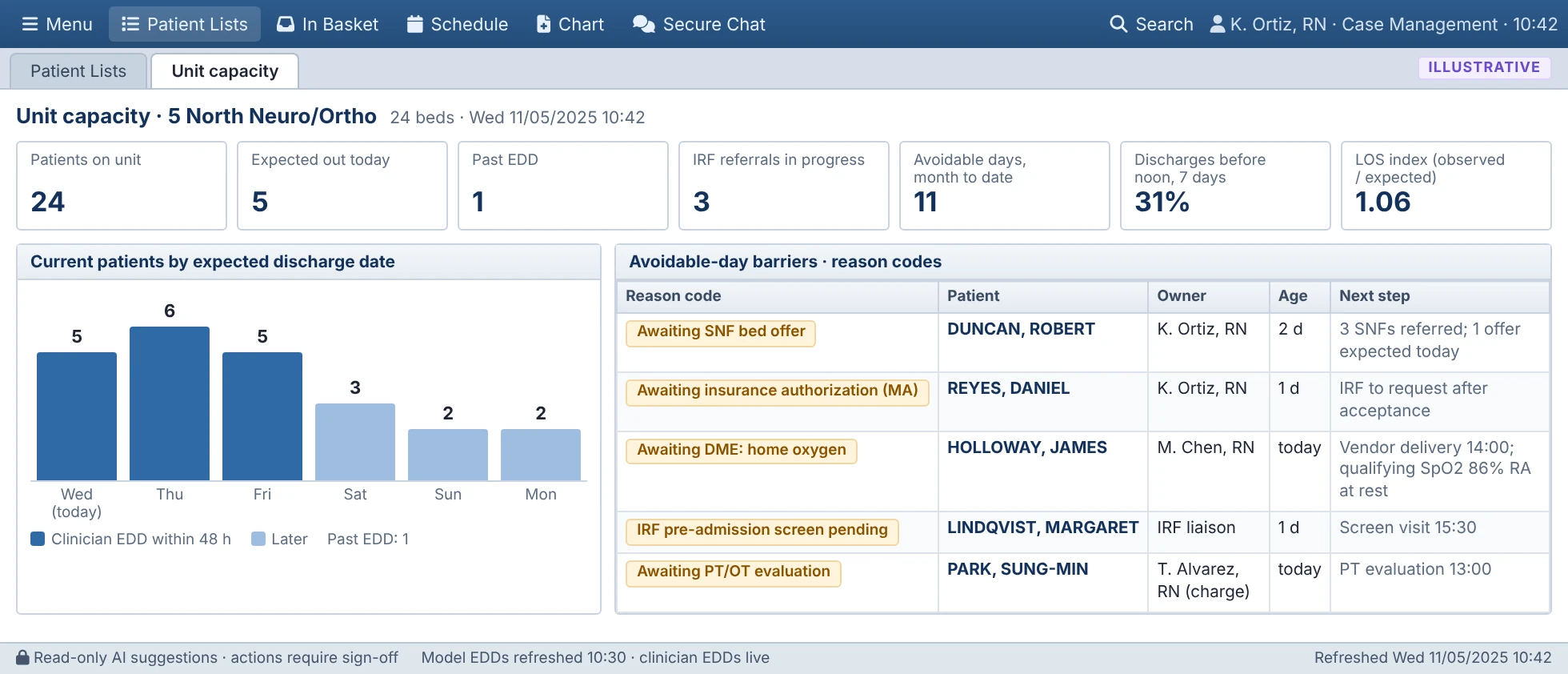
One shared view for the huddle: charge nurses and nurse managers see expected discharges by day and every barrier with an owner. Bedside nurses get no new alerts, tasks or documentation.
What changes for each nurse
| Role | What they see | What they do differently |
|---|---|---|
| Bedside nurse | By default, no new alerts, pages, pop-ups or required documentation | No new bedside tasks by default. Aurifex reads documentation that's already in the chart |
| Charge nurse | The unit view: expected discharges today and tomorrow, and open barriers | Uses it in the huddle and assigns barriers the unit owns, such as a pending therapy evaluation |
| Nurse manager or unit director | Barriers by age, avoidable days by reason code and the unit's measures | Escalates barriers that stay open and looks for the delays that repeat each week |
| Time ask in a pilot (estimated) | Per week |
|---|---|
| Nurse manager or unit director | About 30 minutes, plus the daily huddle you already run |
| Charge nurse | Inside the existing huddle; no added meetings |
| Bedside nurse | None by default |
The expected discharge date of record is set by the care team, usually the attending with the case manager. The model's date sits beside it and never replaces it.
The huddle
- Confirm the patients expected out today and tomorrow.
- Review anyone past their expected date and the barrier behind it.
- Look at new rehab flags, so therapy evaluations are scheduled early.
- Leave with an owner and a next step on every open barrier.
What this doesn't add to nursing
No unit or nurse rankings, and no per-nurse reports. Views aggregate by unit and role only.
- No barrier is assigned to a bedside nurse by default. Barriers go to the role your unit chooses.
- Reassign or mark "not ours" in one click. A misrouted barrier goes back to the right owner.
- Discharges before noon is a unit planning count, never shown per nurse. Past-expected-date counts are planning work too, never a score for a person or a unit.
- No new documentation. Charge nurses use the unit view in the huddle they already run.
- Barrier routing is built by your Epic analyst. During set-up, within the hours in the IT effort table.
Safety and alerts
- A patient is never discharged or moved because of a predicted date. Discharge readiness is a clinical decision.
- Barrier notifications go only to the owner and the unit leader. Never a page or pop-up. Your team sets the channel, the threshold (for example, a barrier open more than 24 hours) and a daily cap on notifications.
Nursing in a pilot
A nurse manager or unit director from each pilot unit joins the weekly review, about 30 minutes a week plus the daily huddle you already run.
- Charge nurse use of the unit view in the huddle
- Barriers closed, by owner
- Barrier age
- Discharges before noon
- Notifications per charge nurse per shift
Each is reviewed weekly and reported at the end of the pilot; discharges before noon are baselined at kickoff.
Nursing measures are baselined on each unit at kickoff. See the evaluation results.

See Aurifex on your own discharge workflow
We'll walk through your worklist, a drafted referral and how a pilot would be measured on your units.