Platform · Unit capacity and barriers
Expected discharges by unit for today and tomorrow
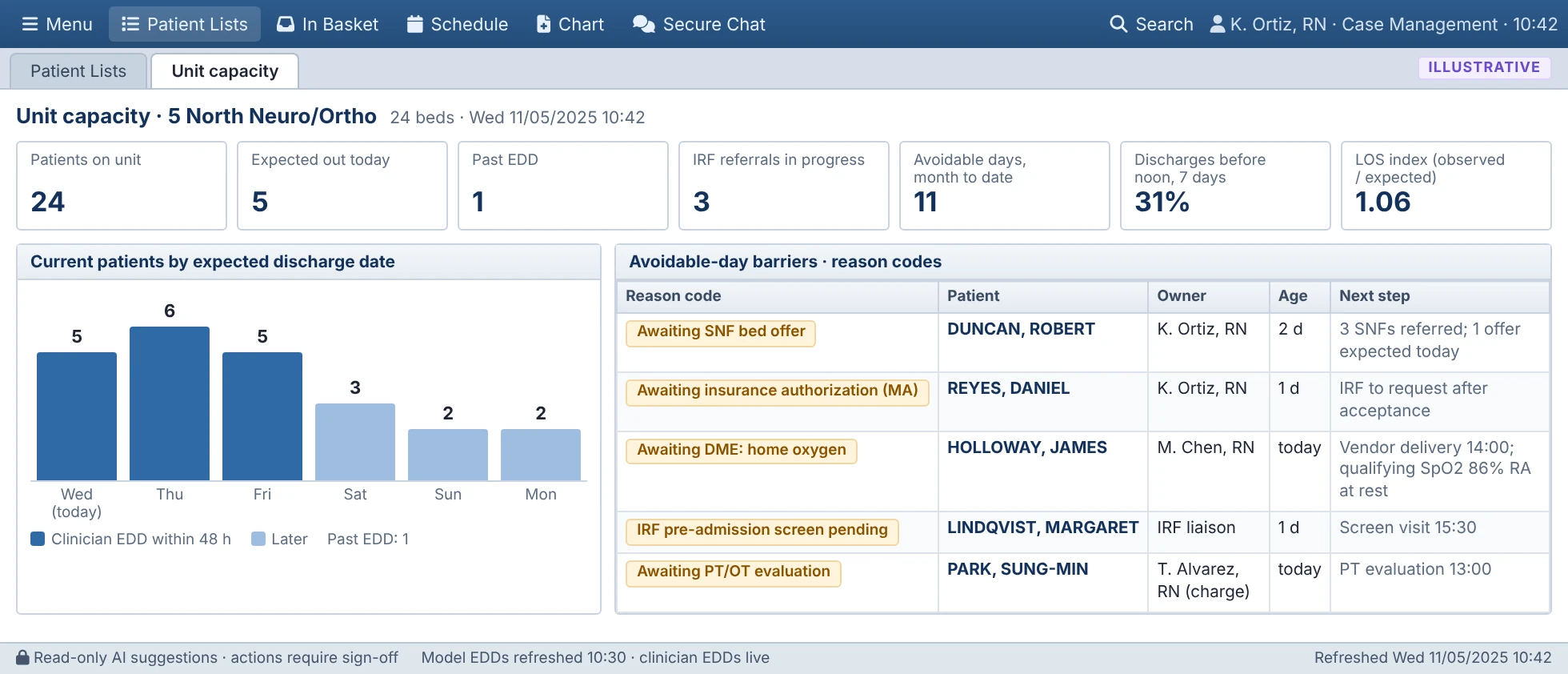
The capacity view shows expected discharges by unit and day, and every avoidable-day barrier with a reason code, an owner, its age and the next step. Qventus, Epic Capacity Management or your command center keep running the bed board; Aurifex supplies the discharge forecast and the barrier reasons. Forecast accuracy is measured in a pilot, against actual discharges.
Today and this week
See by 9 a.m. which beds are likely to open today and over the next two days. It is a forecast, not a guarantee.
The capacity view counts current patients by expected discharge date, for each unit and for the hospital. Dates the clinician set within the next 48 hours are shown apart from later model estimates. Tiles cover patients on the unit, expected out today, past expected date, rehab referrals in progress and avoidable days this month.
Your bed plan and the emergency department
When inpatient beds don't open, admitted patients wait in the emergency department. The forecast shows bed management which beds are likely to open. It does not assign beds or move ED patients.
- Hospital view. Expected discharges by unit and day, rolled up for the house supervisor and bed management.
- Alongside your command center. Aurifex doesn't replace a capacity command center or bed management system. It adds the discharge forecast and the barriers behind each late discharge.
- Owned at the morning huddle. The house supervisor and bed management use the hospital view to plan admissions against the beds likely to open.
| Forecast feed | Detail |
|---|---|
| Delivery | A FHIR-readable list or a CSV feed to your capacity tools, available on request |
| Refresh | Hourly during the day |
| Fields | Unit, date, expected discharges (clinician-set and model), open barriers by reason |
| Accuracy | The unit-level forecast of beds opening by 5 p.m. is compared with actual discharges during a pilot |
Barriers by reason code
An avoidable day is a day a patient stays after they no longer need hospital care. The view lists each one with a standard reason code.
| Reason code | Typical owner | Example next step |
|---|---|---|
| Awaiting post-acute bed offer | Case manager | Follow up with the facilities on the choice list |
| Awaiting insurance authorization | Case manager or utilization review | Check the status with the plan or the accepting facility |
| Awaiting equipment, such as home oxygen | Case manager | Confirm the vendor's delivery time |
| IRF pre-admission screening pending | IRF liaison | Confirm the screening visit |
| Awaiting PT or OT evaluation | Charge nurse or therapy lead | Schedule the evaluation for today |
| Patient or family choice pending | Case manager or social worker | Set a time for the family conversation |
| Guardianship or no payer source | Social worker | Confirm the next legal or financial step |
| Awaiting transport | Case manager | Confirm the pickup time |
Each barrier shows who owns it, how long it has been open and the next step. Barriers that stay open past the time your team sets notify their owner and the unit leader, by default as one digest per owner per shift, in an In Basket message or a worklist banner, never a page or pop-up. Past-expected-date patients are the huddle list: flag, owner, bed released. They are shown as planning work, not as a score.
Unit measures
What the view counts on each unit. How a pilot baselines them
LOS index
Observed stay divided by expected stay (GMLOS). Below 1.00 is shorter than expected for the case mix.
Before noon
Inpatient discharges with a discharge time before 12:00, as a share of all inpatient discharges, by unit, over the last seven days.
Avoidable days
Month to date, totaled by reason code, so the biggest recurring cause is obvious.

See Aurifex on your own discharge workflow
We'll walk through your worklist, a drafted referral and how a pilot would be measured on your units.