Platform · Inpatient rehab referrals
Rehab candidates found early, with the referral drafted
Aurifex reviews each admission's notes as they accumulate, flags patients who may qualify for acute inpatient rehabilitation and drafts the referral packet. A case manager reviews, edits and sends it. Drafted packets cover inpatient rehab today. SNF and home health referrals still follow your usual process.
How candidacy is handled
- Aurifex flagsPatients whose notes show the evidence an IRF reviews. The flag is a prompt to look.
- PM&R and the IRF decideThe attending and PM&R determine candidacy, and the IRF's pre-admission screening decides admission.
- How often a flag is right (precision)80% of raised flags are candidates, against expert-labeled cases. About 1 in 5 flags is not a candidate.
- How many candidates it finds (recall)88% of candidates are flagged. Missed candidates are a standing category in weekly review, and your usual referral process is unchanged.
The flag threshold and the weekly cap on pended consults are set with your PM&R lead at kickoff. Aurifex prepares only the pre-admission packet: the IRF-PAI, the post-admission physician evaluation and the individualized plan of care belong to the IRF.
References: IRF coverage criteria in 42 CFR 412.622(a)(3) and the Medicare Benefit Policy Manual, Chapter 1, Section 110.
The Possible IRF flag
Rehab candidates can be found late, when the patient is nearly ready to leave and the referral still has to be written from days of notes.
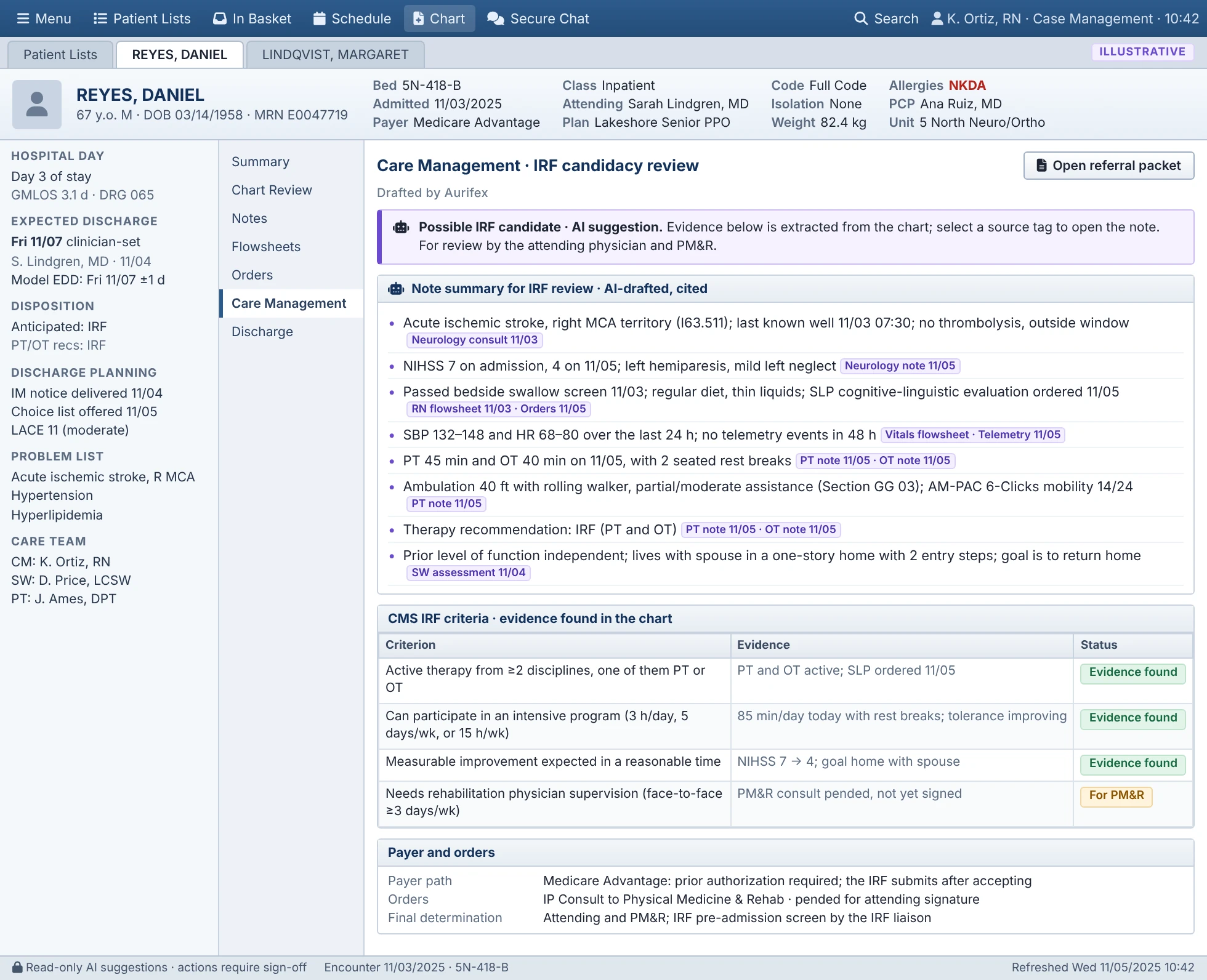
Aurifex reviews each new admission and keeps reviewing as notes arrive. When the evidence points toward acute inpatient rehabilitation, a Possible IRF flag appears in the worklist. It looks for the evidence an IRF admissions team asks for.
- Condition, such as stroke, hip fracture, brain or spinal cord injury and major multiple trauma, from the CMS-13 list and beyond it
- Function now and before admission, in Section GG terms and mobility scores such as AM-PAC 6-Clicks
- Therapy: PT and OT recommendations, minutes tolerated and rest breaks needed
- Medical stability: vital-sign trends, telemetry events and swallow screening
- Home and support: home setup, entry steps and caregiver availability
The flag is a prompt to look. In testing, at the worklist threshold: 88% recall and 80% precision, with an AUROC of 0.91. At 80% precision, about 1 in 5 flags is not a candidate; expect about 5 to 6 flags per 100 admissions, since about 5% of discharges in the historical data went to inpatient rehab.
What the IRF reviews, and what Aurifex looks for
Opening a flagged patient shows a cited note summary and each criterion with the evidence found, or a clear note that none was found. The case manager reviews the evidence and its sources instead of searching the chart for them.
The criteria, row by row
| What the IRF reviews | What Aurifex looks for |
|---|---|
| Active and ongoing therapy from two or more disciplines, one of them PT or OT | Active PT and OT orders and notes, plus SLP where ordered |
| Able to take part in an intensive program, generally 3 hours a day at least 5 days a week, or 15 hours over 7 days when documented | Therapy minutes tolerated, rest breaks and the trend over recent sessions |
| Expected to make measurable improvement in a reasonable time | Gains in function and neurological scores, therapy goals and the discharge goal |
| Needs supervision by a rehabilitation physician, with face-to-face visits at least 3 days a week | Decided by PM&R, not assessed by Aurifex. It notes medical complexity and whether a PM&R consult is ordered |
| Needs an intensive, coordinated interdisciplinary approach | The combination of therapy, nursing and medical needs documented in the chart |
| Needs more than a skilled nursing facility can provide (clinical judgment, not a CMS criterion) | Therapy intensity and medical needs that point past a SNF level of care |
| A rehabilitation physician reviews and agrees before admission | Decided by the IRF and PM&R, not assessed by Aurifex. Aurifex prepares what the screener needs |
The CMS-13 list sets an IRF's compliance threshold, not a patient's eligibility. Patients with other diagnoses or several comorbidities can be flagged when the notes show therapy needs and expected gain, and the final call stays with PM&R.
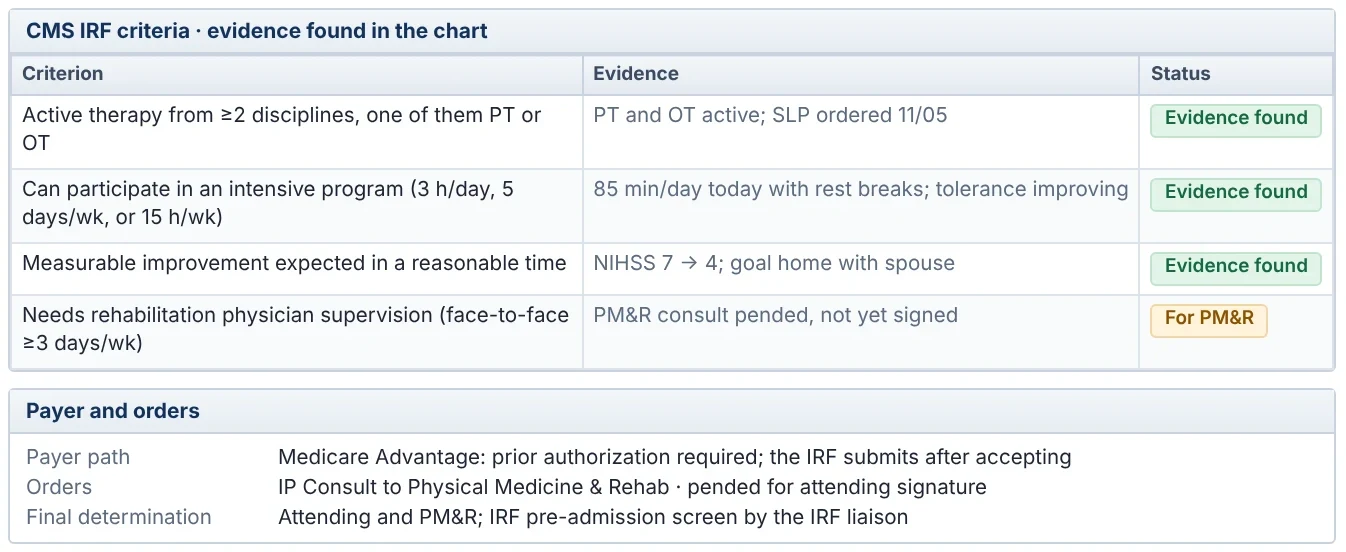
The final determination belongs to the attending physician and PM&R, and the IRF's own pre-admission screening decides admission. Aurifex lays out the evidence.
The PM&R consult, drafted for the attending to sign
A consult to Physical Medicine and Rehabilitation is a provider order, so Aurifex drafts it as a pended order (an order waiting for a physician's signature) with a cited reason for consult. The attending reviews, edits and signs it, or declines it. Nothing is ordered on its own.
In blinded review of 400 drafts by 3 PM&R physicians and 3 case managers, 85% were rated acceptable as written or with minor edits.
The referral packet
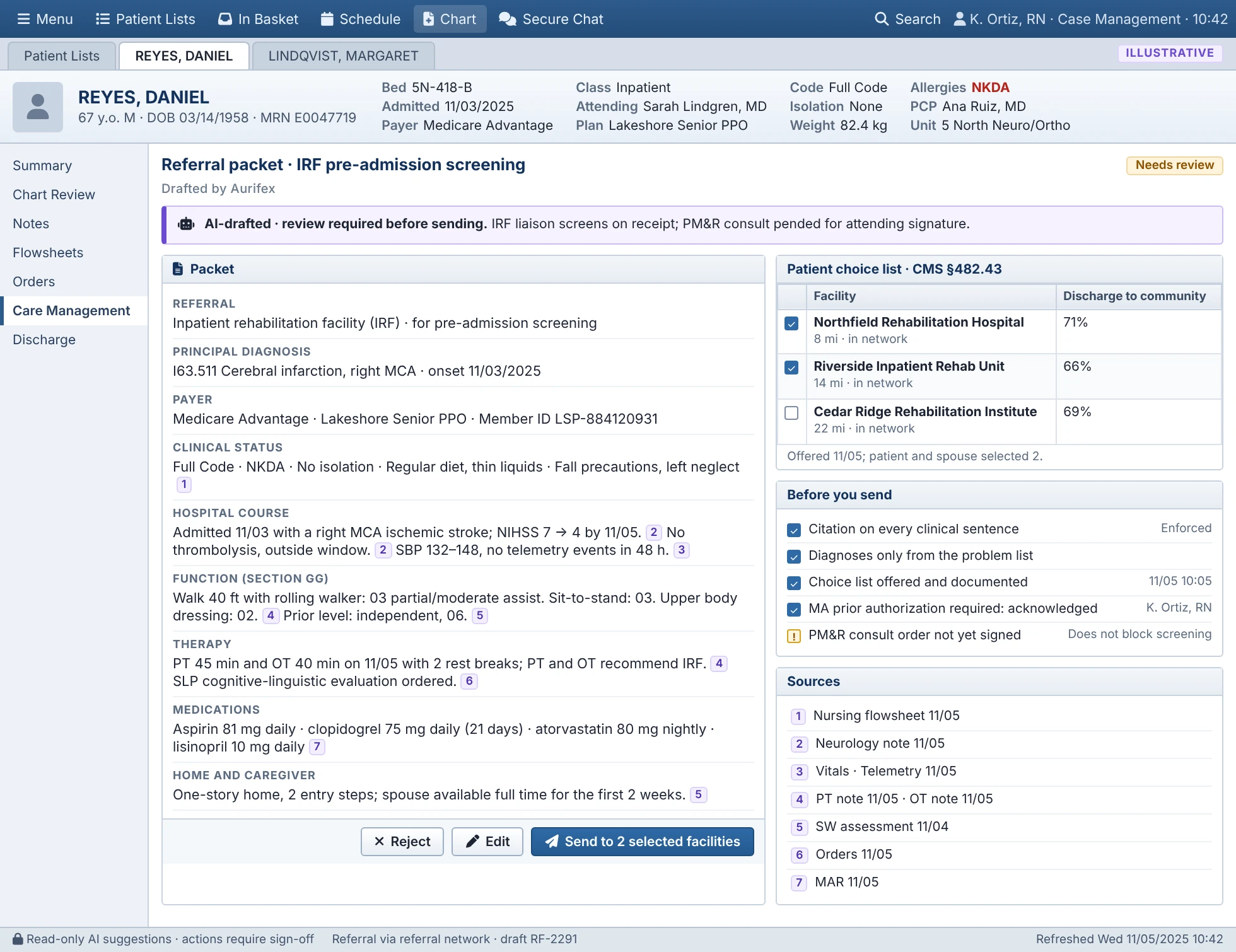
While the consult is pending, the referral packet is drafted for the case manager. It gathers what an IRF admissions liaison needs for pre-admission screening, and every clinical sentence carries a numbered citation to its source.
What's in the packet, and what's checked before sending
In the packet
- Demographics, payer and member ID
- Principal diagnosis with ICD-10 code and onset date
- Hospital course, vital signs, key labs and medications
- Diet and swallow status, precautions, isolation and code status
- Current and prior level of function in Section GG terms
- Therapy needs across PT, OT and SLP
- Home setup and caregiver support, attending, PM&R consult and PCP
Checked before sending
- Patient choice list offered and documented
- A citation on every clinical sentence
- Diagnoses taken only from the problem list
- Allergies, code status and isolation present and current
- Payer authorization status acknowledged
Patient choice and the payer path
Under the CMS discharge planning rules in 42 CFR 482.43, patients choose among the post-acute providers available to them, in or out of network, and the hospital discloses any financial interest it has in a listed provider. Aurifex prepares a choice list of IRFs with publicly reported quality data, noting which are in the patient's network, and the case manager documents what the patient and family selected.
| Payer | What happens before admission | How Aurifex handles it |
|---|---|---|
| Traditional Medicare | No prior authorization. The IRF completes a pre-admission screening within the 48 hours before admission. | The packet goes straight to the selected IRFs for screening. |
| Medicare Advantage and commercial plans | Prior authorization is usually required, and is often requested by the IRF after it accepts. | Sending is blocked until the case manager acknowledges the authorization step, and its status is tracked as a barrier. |
We follow the plan's own criteria and your utilization review process. Aurifex doesn't change status determinations or Condition Code 44 decisions.
The approved packet goes to the selected facilities through the referral platform your hospital already uses.
Payer authorization and Medicare Advantage
- Drafts the clinical summary an authorization request needs, with sources
- Tracks the authorization status as a barrier, with the days spent waiting
- Shows the plan's path, such as whether the IRF submits after accepting
It never submits to a payer or speaks to one, requests or conducts a peer-to-peer review, or decides what to do after a denial.
Medical-necessity reviews by Medicare Advantage plans are a common source of delay. A complete, cited packet helps the reviewer, and the days spent waiting are visible to the unit team so the delay doesn't go unnoticed.
How the rehab numbers were tested
What each rehab number counts, and how it was measured in testing.
| Number | Numerator | Denominator | How it was tested |
|---|---|---|---|
| 95% overall agreement | Cases where the flag (flag or no flag) matched the expert label | 2,000 expert-labeled admissions (240 candidates) | Against expert labels; recall 88% and precision 80% at the worklist threshold |
| 85% consults acceptable | Drafted consults rated acceptable as written or with minor edits | 400 drafted consults | Blinded review, two of 6 clinicians per draft; 95% CI 81–88% |
| 1.5% hallucination rate | Draft statements their cited source didn't support | 6,000 reviewed draft statements | Each statement checked against its cited source |
| 45→10 minutes per IRF referral | Case-manager minutes to prepare a referral, by hand and then reviewing a cited draft | 60 simulated cases, timed with 6 case managers (median) | Workflow testing on simulated cases; IRF packets only, including the review |
How recall is measured: on historical data; a pilot checks it against discharged patients who went to rehab without a flag.
Questions
Does Aurifex decide who goes to rehab?
No. It flags possible candidates and lays out the evidence. The attending and PM&R decide, and the IRF's liaison screens every referral.
What if an appropriate candidate isn't flagged?
Nothing changes for the patient: your team refers through its usual process, and case managers can open the candidacy review for any patient. Missed candidates are a review category in weekly clinician review, reviewed with you.
Does it cover skilled nursing and home health referrals too?
The disposition prediction covers home, home health, SNF, IRF and LTACH. Drafted referral packets are built for IRF only, where the evidence burden is highest.

See Aurifex on your own discharge workflow
We'll walk through your worklist, a drafted referral and how a pilot would be measured on your units.