Solutions · Executives and finance
Shorter stays, measured against your own baseline
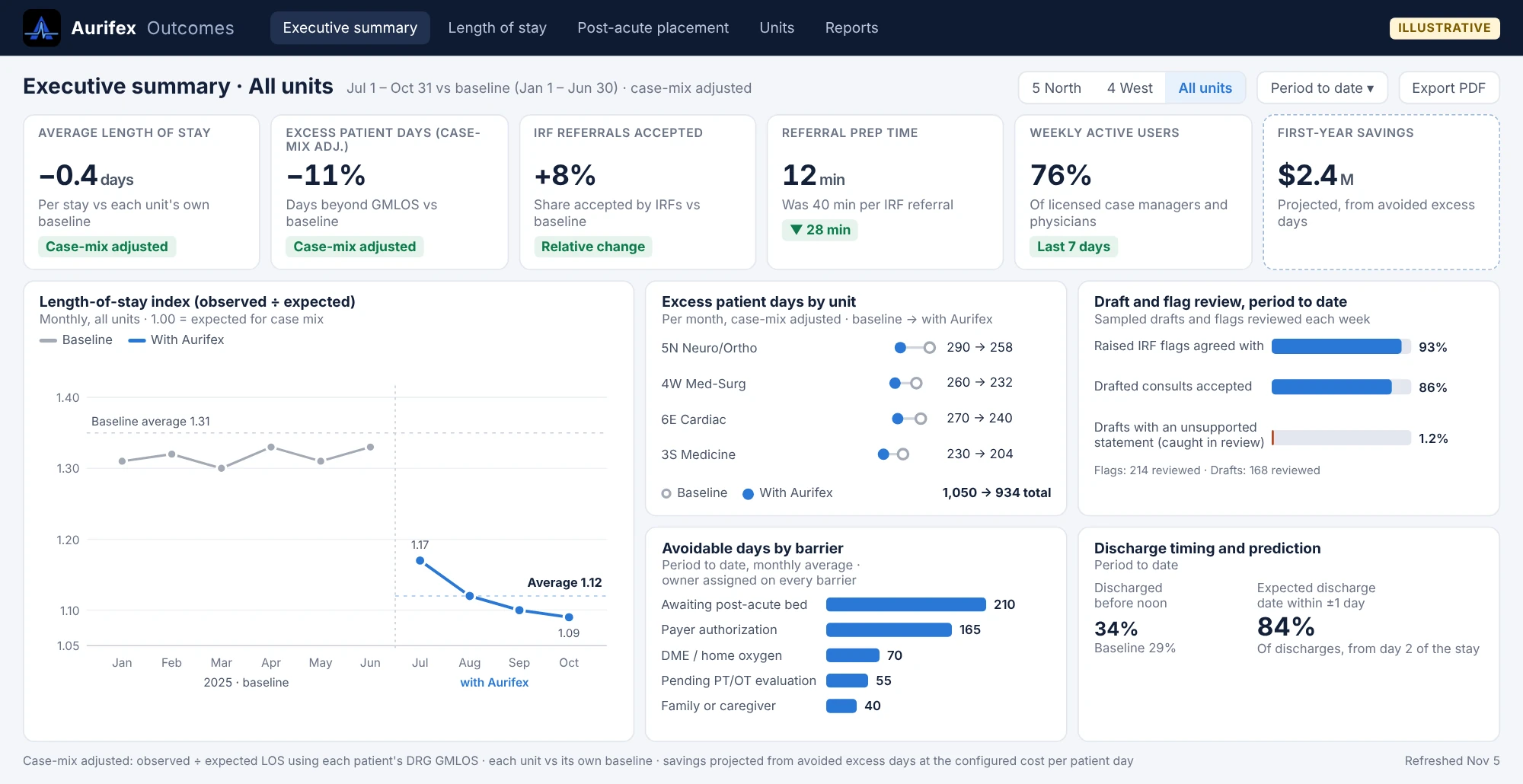
Length of stay and excess days are adjusted for case mix and measured against your own units' baseline. Savings stay labeled as projected until your finance team confirms them.
The case for discharge and placement
A day a medically ready patient stays is a day of cost without added DRG payment, and a bed the next patient can't use.
Aurifex works on the days between medical readiness and the next place of care. It finds the patients who'll need a post-acute bed earlier, cuts the time to build a referral and gives every barrier an owner.
- Capacity. A pilot measures days from medically ready to discharge, split by IRF, SNF and home, against your baseline. The discharge forecast helps bed management plan admissions from the emergency department.
- Margin. Fewer excess days under DRG payment, where the extra day isn't paid. Value depends on whether the freed bed is refilled.
Where an avoided day saves money
The value of a shorter stay depends on how the stay is paid. The cost basis is set with your finance team.
| Payment | What an avoided excess day does |
|---|---|
| DRG-paid stays (traditional Medicare and most DRG contracts) | Cost is avoided and payment is unchanged, so the day is margin and a freed bed |
| Per-diem contracts | Revenue and cost both fall, so the value is mostly the freed bed for another admission |
| Medicare Advantage | Depends on the contract: DRG-based contracts behave like traditional Medicare, per-diem contracts like per diem |
Two limits worth knowing: the 85%+ discharge-date accuracy was measured on held-out historical admissions, and results on your units depend on your baseline and case mix.
What you see
- Length of stay and excess days, case-mix adjusted, by hospital and unit.
- Use next to outcomes, so you can see whether results follow use.
- The same measures across patient groups, for ACA Section 1557.
- Exports for committee packets, with the method attached.
Size the opportunity
- Patient days freed = annual discharges on the units × days saved per stay
- Beds' worth of capacity = patient days freed ÷ 365
- Projected value = patient days freed × your cost per day × the share you expect to realize
Worked example, with example inputs only: 12,000 discharges × 0.5 days per stay (an example input, not an expected result) = 6,000 patient days freed; 6,000 ÷ 365 ≈ 16 beds' worth of capacity. These are the calculator's example values, not a forecast.
The value depends on your payment model and on whether freed beds are refilled.
Post-acute and value-based contracts
A pilot measures the days from medically ready to placement and the mix of inpatient rehab and skilled nursing placements on your units. It doesn't claim changes in readmission penalties, bundle spend or shared savings; readmissions are tracked as a balancing measure.
Starting a pilot
A pilot is planned to cover one or two units over about 20 weeks, ending with a case-mix-adjusted review, a one-page summary for your executive team and board, and a decision on whether to expand. Success measures, and the level each must reach to justify expanding, are agreed at kickoff. Your team's time is listed role by role on the pilot page.
Pilot pricing on request
One fixed fee for the 20-week pilot, scoped by the number of units, with no fee tied to savings. After the pilot, an annual subscription priced per licensed bed. How pricing is built.

See Aurifex on your own discharge workflow
We'll walk through your worklist, a drafted referral and how a pilot would be measured on your units.